A/Prof Patrick Jory
Title: Asia Literacy and the Mystery of the Disappearing History
Abstract: In the boom period of Asian Studies in Australia in the 1980s and 1990s, History, along with Asian languages, was central. Studying history was considered a natural and uncontroversial part of understanding the Asian region. Many of the most prominent scholars in the field, and even administrators of Asian Studies programs, were historians. There was an outpouring of research publications in Asian history, some of which remain classics in the field. Fast forward to 2026 and Asian history has largely disappeared from Australian universities as a discreet course of study. Among administrators there is little concrete support for it. What happened, and why? This paper will explain the strange disappearance of History from the study of Asia and discussions of Asia literacy, and why the study of Asian languages and history must be reconnected.
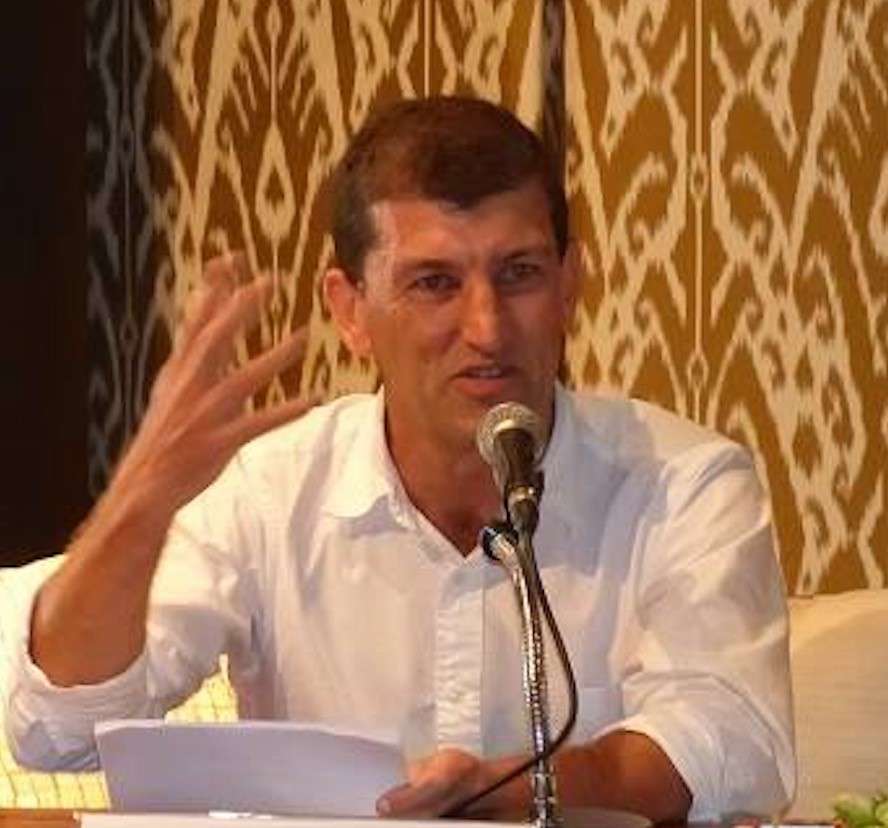 Bio: Patrick Jory is Associate Professor in History in the School of Historical and Philosophical Inquiry at the University of Queensland. From 2017-22 he was inaugural president of the Association of Mainland Southeast Asia Scholars (AMSEAS). His research interests are in modern Southeast Asian history, with a focus on Thai history. He is winner of the Asian Studies Association of Australia Mid-Career Book Prize in 2022 for A History of Manners and Civility in Thailand (Cambridge University Press, 2021), and a CHOICE Outstanding Academic Titles Award for Thailand’s Theory of Monarchy: The Vessantara Jataka and the Idea of the Perfect Man (State University of New York Press, 2016). Much of his work has been published in Thai translation. In 2024 he was elected to the Australian Academy of the Humanities. He is cohost of the New Books in Southeast Asian Studies podcast channel, part of the New Books Network: https://newbooksnetwork.com/hosts/profile/d1ad4bb7-4d47-465f-a052-4e4fb779cc16
A/Prof Adam Bowles
Title: Why (did I) learn Sanskrit?
 Abstract: Sanskrit, it is said, is dead. Why learn it, then? Why did I, as a person of non-South Asian heritage, choose to learn it? And why do I keep reading things composed in it? This presentation will be part autobiographical reflection, part argument for a properly global Humanities, which must have language capability at its heart to enable literary, cultural, and historical engagement.
Session 1
Dr Lucila Etsuko Gibo
Title: Speaking Uchinaaguchi in Brazil: The Role of language in preserving Okinawan historical identity within the Japanese diaspora
Abstract: This presentation explores the role of Uchinaaguchi (the Okinawan language), focusing on its contribution to the preservation of Okinawan historical identity within the Japanese immigrant community in Brazil. It begins with an introduction to Uchinaaguchi in the Ryukyuan linguistic context, highlighting its distinct status in relation to standard Japanese. It then outlines the historical background of Okinawan migration to Brazil and the social factors that influenced language use inside and outside the community. A central focus is placed on language maintenance and intergenerational transmission. Despite a language shift towards Portuguese and standard Japanese, Uchinaaguchi continues to hold both symbolic and communicative value among descendants of Okinawan immigrants. Its continued use in multilingual contexts has contributed to the emergence of a mixed language, which serves as an in-group marker of ethnic and cultural identity. This presentation also discusses second- and third-generation speakers’ perceptions of the value of the language, as well as their motivations for learning and maintaining it. By situating Uchinaaguchi within the broader framework of Japanese diaspora studies, this study argues that language functions not only as a means of communication but also as an essential element in connecting present-day communities with their historical heritage.
Pohling Tan
Title: From digital community to translocal heritage network: SayMin and the historicisation of Hokkien language revitalisation
Abstract: This paper examines SayMin (说咱闽南话), a grassroots Hokkien language revitalisation initiative originating in Fujian, as a case study in community-led heritage language practice that embeds historical consciousness into language learning. Founded in 2018 as a digital platform, SayMin has evolved from a UGC-based mobile application into a translocal network connecting diaspora Hokkien communities across Hong Kong, Macau, and Southeast Asia. Drawing on the presenter's experience as a founding team member and subsequent researcher, this paper analyses how SayMin's programming — including qiaopi (侨批, overseas remittance letter) themed workshops in Singapore, community salons foregrounding topolect identity, and the establishment of overseas transmission centres — deliberately repositions Hokkien not as a communicative utility but as a bearer of migration history and collective memory. This approach directly challenges the ahistorical framing of Asian language education critiqued in Australian policy contexts. For Hokkien-speaking diaspora communities in Australia — many of whom trace roots through Malaysia, Singapore, and Indonesia — SayMin's model offers a transferable framework in which language revitalisation is inseparable from recovering the histories that languages carry. The paper concludes by reflecting on the potentials and limits of community-driven, historically-grounded topolect practice for heritage language education in multicultural societies, attending also to the methodological tensions inherent in researcher-practitioner positionality within community language movements.
Thy Le & Dr Mi Yung Park
Title: If I could go back in time, I would tell my mom to teach me Vietnamese”: Heritage language suppression and identity among mixed-heritage Vietnamese youth
Abstract: This study investigates heritage language (HL) learning and identity reconstruction among mixed-heritage Vietnamese students in Aotearoa New Zealand. Drawing on a narrative frame and semi-structured interviews, the study explores the experiences of two university students: Andy (Vietnamese Chinese) and Julia (Vietnamese-White New Zealander). Poststructuralist theories of identity (Darvin & Norton, 2015; Norton, 2013; Weedon, 1997) are used to examine their motivations and investment in Vietnamese HL learning. Both participants reported experiencing suppression of Vietnamese HL use during childhood, primarily due to their mothers’ preference for integration into New Zealand society and reluctance to maintain Vietnamese. This process impacted the participants’ ambivalent identities shaped by both imposed and agentive forces, and by connections and disconnections with their Vietnamese HL and culture. Specifically, Andy was instructed to identify solely as Chinese rather than Vietnamese, while Julia was pressured to conform to White cultural norms. These early constraints later prompted the participants to exercise greater agency in investing in Vietnamese learning as adults and (re)claiming their Vietnamese ethnic minority identities. This study thus highlights the complex interplay between parental language ideologies, early linguistic environments, and individual agency. It underscores the importance of family, community, and institutional support in HL transmission and identity (re)construction among mixed-heritage youth.
Session 2
Dr Angela Cook, presented by Dr Chunxuan Shen
Title: Recent language change in spoken Mandarin: Implications for teaching practice
Abstract: Recent research has revealed noticeable shifts in lexical and grammatical features of Mandrin Chinese in authentic speaking contexts. Based on a corpus of half a million characters of spoken Mandarin, drawn mostly from popular Chinese chat shows, this research traces changes in patterns of attested language use over a 15-year period, from 2005 to 2020. The paper summarises observations on diachronic changes in the use of three selected features of spoken Mandarin: the lexeme 姐 jie (‘big sister’) (Cook & Zheng, under review); the morphological plural suffix 们 men (Cook & Yao, 2025); and the syntactic passive marker 被 bei (Cook & Yao, in preparation). Taken together, the findings show that spoken Mandarin is evolving in some surprising and perhaps unpredictable ways. In the field of Chinese as a second language (CSL) teaching, where textbooks have a reputation for lagging behind actual language use, this research is a timely reminder that no living language is static and that we have an obligation to ensure that teaching and learning materials accurately reflect contemporary language use.
Wei Wei
Title: Embed language knowledge in everyday teaching practice – an autoethnographic study
Abstract: The latest Australian Curriculum and Early Years Learning Framework (EYLF) clearly mention home language. Teachers and early childhood educators are expected to support children’s home language development. However, students with language background other than English can be vulnerable. My research shows that parents were worried that speaking a home language could lead to teachers’ negative attitudes toward their children. Individuals could feel being isolated when speaking their home languages. In the last symposium, I called out for schoolteachers to openly talk about language. Reflecting on my teaching practice, I used an autoethnographic method to introduce several small classroom activities that can be embedded in everyday teaching practice to increase students’ understanding of language knowledge. I also linked these activities to detailed requirements/expectations in the Australian Curriculum or EYLF. Supporting home language development among children does not necessarily need language skills in home languages. Rather, it can be simply achieved by showing positive attitudes towards children’s language and culture backgrounds.

 Dr Rebecca Cairns is a senior lecturer at Deakin University, on Wadawurrung Country in Geelong. Her research explores Asia-related education and history education through the lenses of curriculum inquiry and decolonising approaches. She co-authored The Asia literacy dilemma: A curriculum perspective (Cairns & Weinmann, 2023). Drawing on Chen’s (2010) Asia as method, she has developed a framework for curriculum and policy analysis. Rebecca’s research continues to examine how ‘Asia’ and ‘Asia literacy’ are discursively constructed in the past and present.